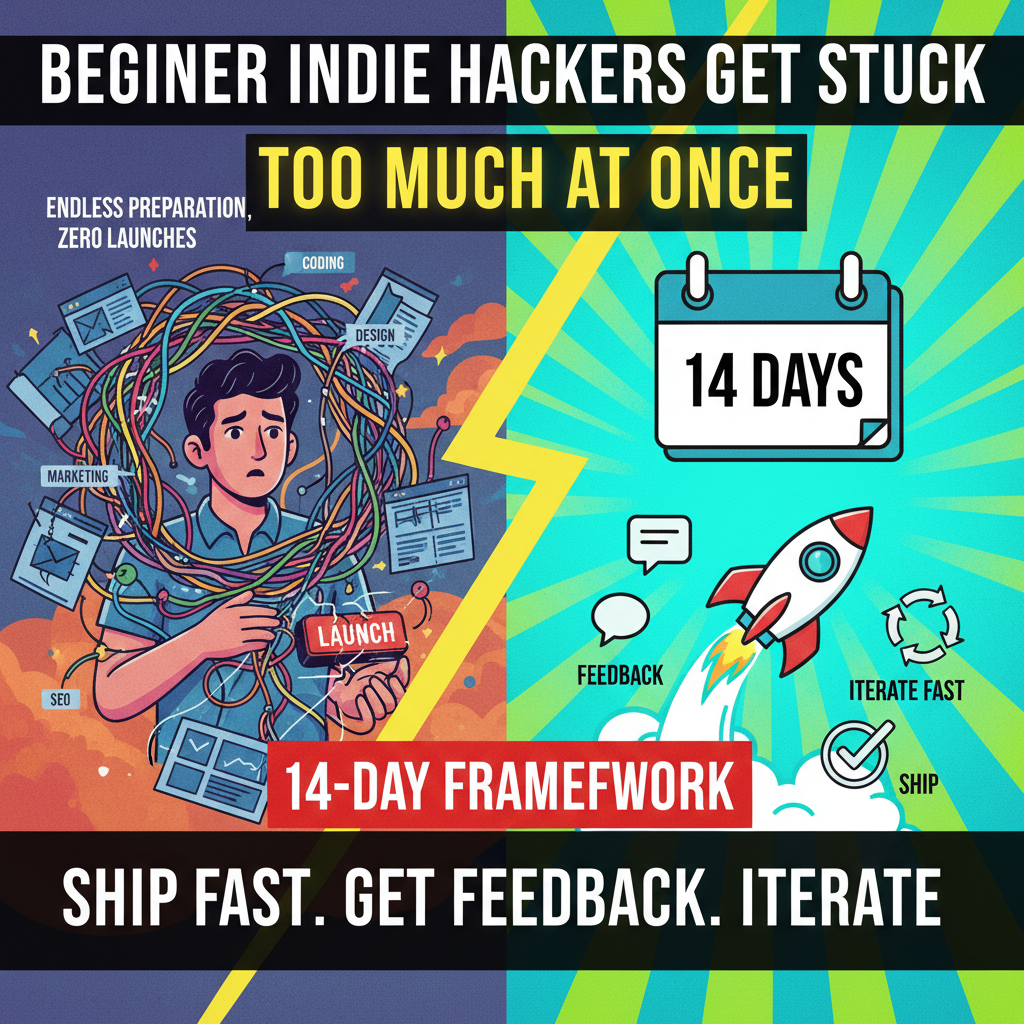
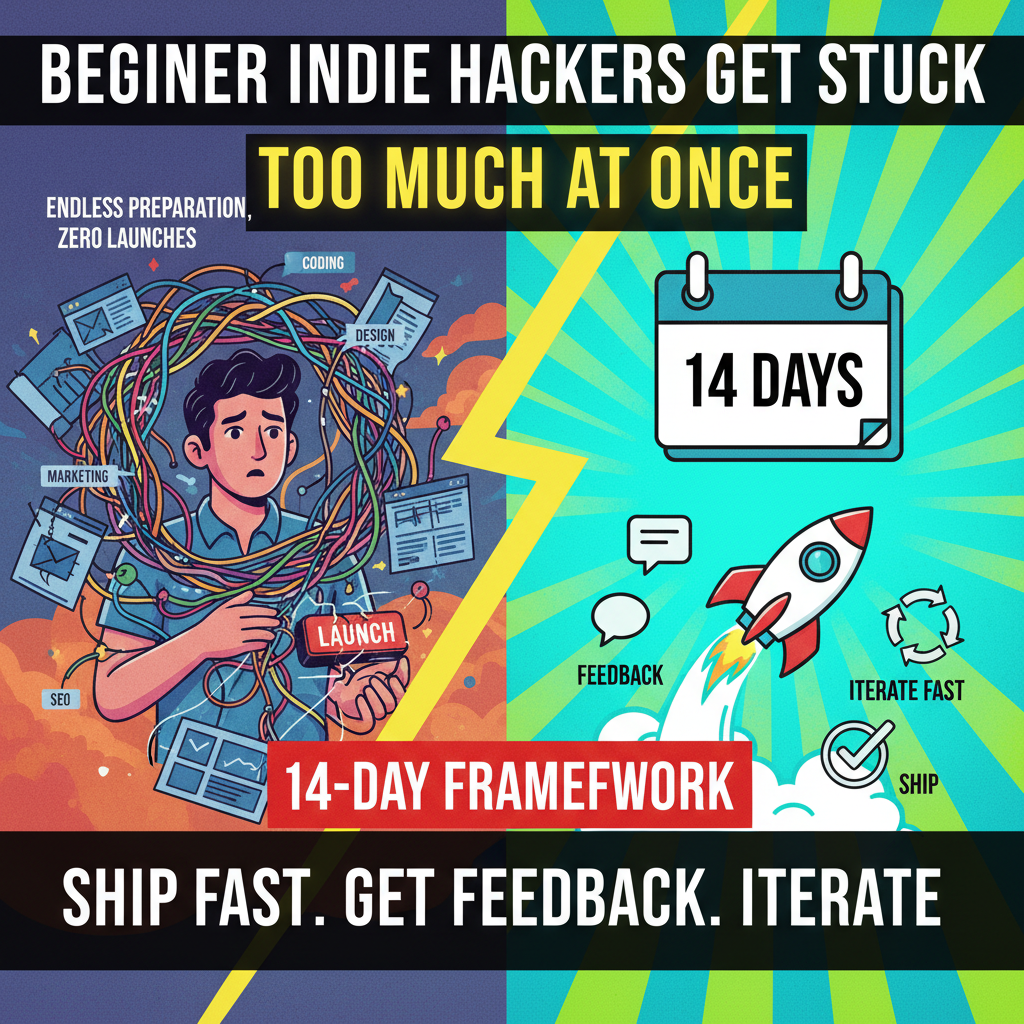
Beginner indie hackers get stuck because they try to handle coding, design, marketing, and SEO all at once. The result: endless preparation, zero launches.
This 14-day framework eliminates the noise. It forces you to ship, get feedback, and iterate fast.
Day 1: Identify a Pain Point
Focus entirely on the problem, not your software solution.
- Goal: Pinpoint a specific daily frustration.
- Core Questions:
- Who has this problem? (e.g., freelance copywriters, Shopify merchants)
- How do they solve it now? (e.g., manual copy-pasting, messy Excel files)
- What tools are they paying for? (e.g., expensive agency software, sub-optimal plugins)
- What is the cost of not solving it? (e.g., losing 2 hours daily, inaccurate reporting)
- Action: Use Reddit, Google Search, and ChatGPT to list 3 potential problems.
Day 2: Market Research
Observe user discussions in communities (Reddit, X, Discord, Facebook groups, Product Hunt). Do not pitch. Just gather evidence.
- Goal: List at least 10 real user complaints.
- Where to look: Subreddits like r/shopify, r/marketing, or niche Facebook groups.
- Log Format:
User quote: "I hate copying my Shopify orders to Google Sheets every night."
Current solution: Manual export/import.
Opportunity: Automated background sync tool.
Day 3: Validate Without Code
Test market demand by posting a feedback-oriented question. Do not sell anything.
- Goal: Get 10 comments, 5 DMs, or 5 waitlist signups.
- Validation Template:
I spend an hour every day manually importing invoices into my tax software.
If there was a tool where you forward the invoice email and it automatically syncs with QuickBooks, would you pay $10/month for it?
- Result: If nobody cares, pivot immediately. The pain isn't big enough.
Day 4: Quick Branding & Landing Page
Launch a simple page to capture emails. Spend no more than 3 hours on this.
- Branding:
- Name: Keep it simple (e.g., SyncCart, TaxFlow).
- Design: Standard font, one primary color, text logo.
- Landing Page Structure:
Value Proposition (Headline + Slogan)
↓
Problem & Solution (Short description)
↓
Email Waitlist Form (CTA)
Day 5: Start Building in Public
Announce your 14-day build on X (Twitter), Reddit, or LinkedIn.
- Goal: Establish accountability and start building an audience.
- Launch Template:
Day 1/14:
I'm building SyncCart to automate Shopify-to-Sheets syncing.
Building in public.
Goal: Ship in 14 days, get 10 beta users.
Follow along.
Days 6 to 10: Build the MVP
Write code for the core logic only. Spend 1-3 hours daily.
- Development Rules:
- Prioritize functionality over aesthetics.
- Skip dashboards, settings, and complex auth if not critical.
- Fix bugs that break the core loop; ignore minor design flaws.
- Customer Discovery: DM the users who engaged on Day 3. Ask:
- "What is the single hardest part of this task?"
- "Why did you stop using your last solution?"
- "What does your dream solution look like?"
Day 11: Launch the MVP
Deploy the product and launch it to your waitlist and communities.
- Launch Channels: Product Hunt, Indie Hackers, target subreddits, X.
- Launch Template:
SyncCart is live.
Automate your Shopify-to-Sheets orders in 1 click.
Need brutal feedback. Please roast it.
[Link]
Day 12: Analyze & Gather Feedback
Review user interactions and follow up immediately.
- Metrics to Track: Signups, drop-off pages, core action completion rates.
- Action: Email every user who signed up. Ask:
- "Did the setup make sense?"
- "What almost stopped you from using it?"
- "What is missing that would make this a daily tool?"
Day 13: Fix Bottlenecks
Spend this day patching the biggest user drop-off points.
- Fix List:
- Onboarding friction (make it 1-click if possible).
- Server errors and critical bugs.
- Confusing UI copy.
- Do Not: Add new features, integrations, or complex setups.
Day 14: Review & Repeat
Complete the first cycle and decide on next steps.
- Daily Operating Routine:
- Morning (30 mins): Reply to support, post updates, check database stats.
- Afternoon: Write code, resolve tickets, optimize flows.
- Evening: Write a 3-point daily recap:
Today I learned: ...
User feedback: ...
Tomorrow: ...
If the loop yields active users, double down. If there is zero interest, pivot to a new problem.