Category: Mindset

  • The Indie Hacker Core Loop

    The Indie Hacker Core Loop

    The Indie Hacker Core Loop

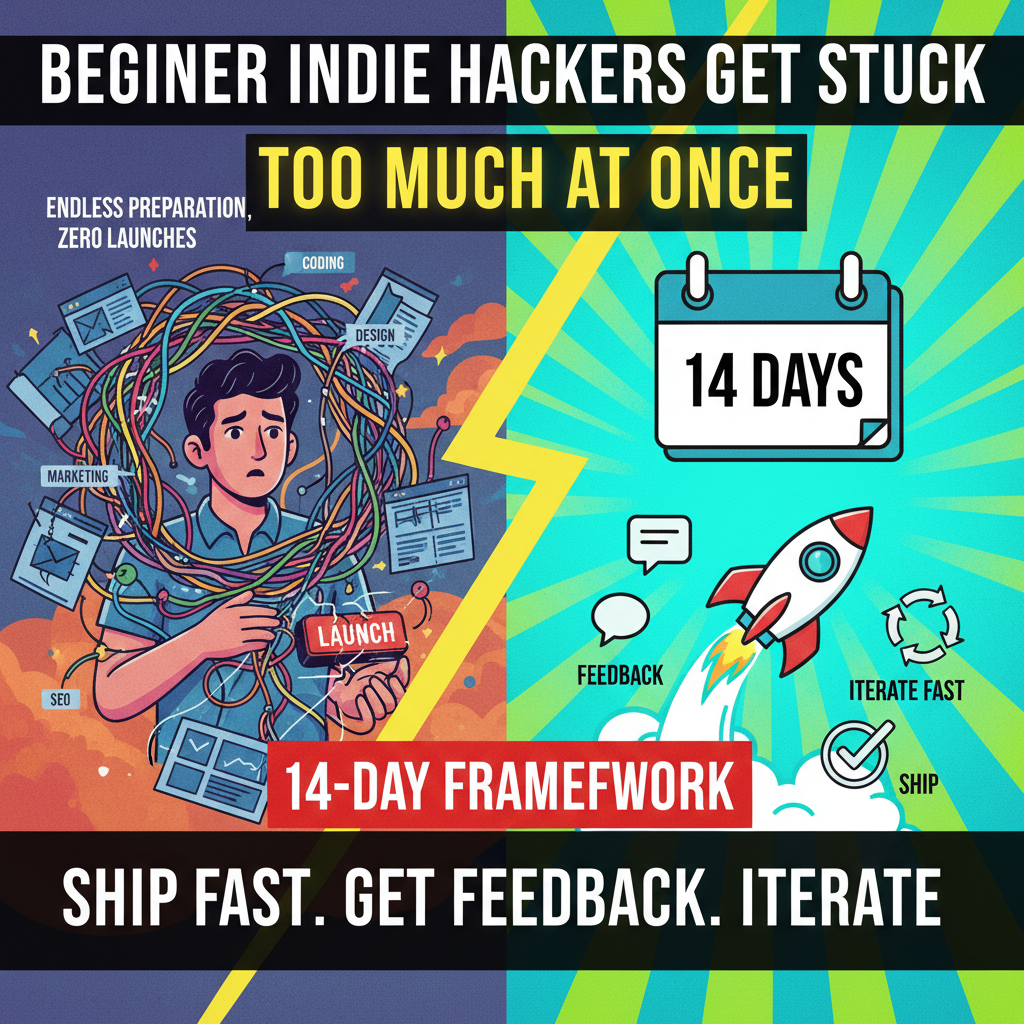
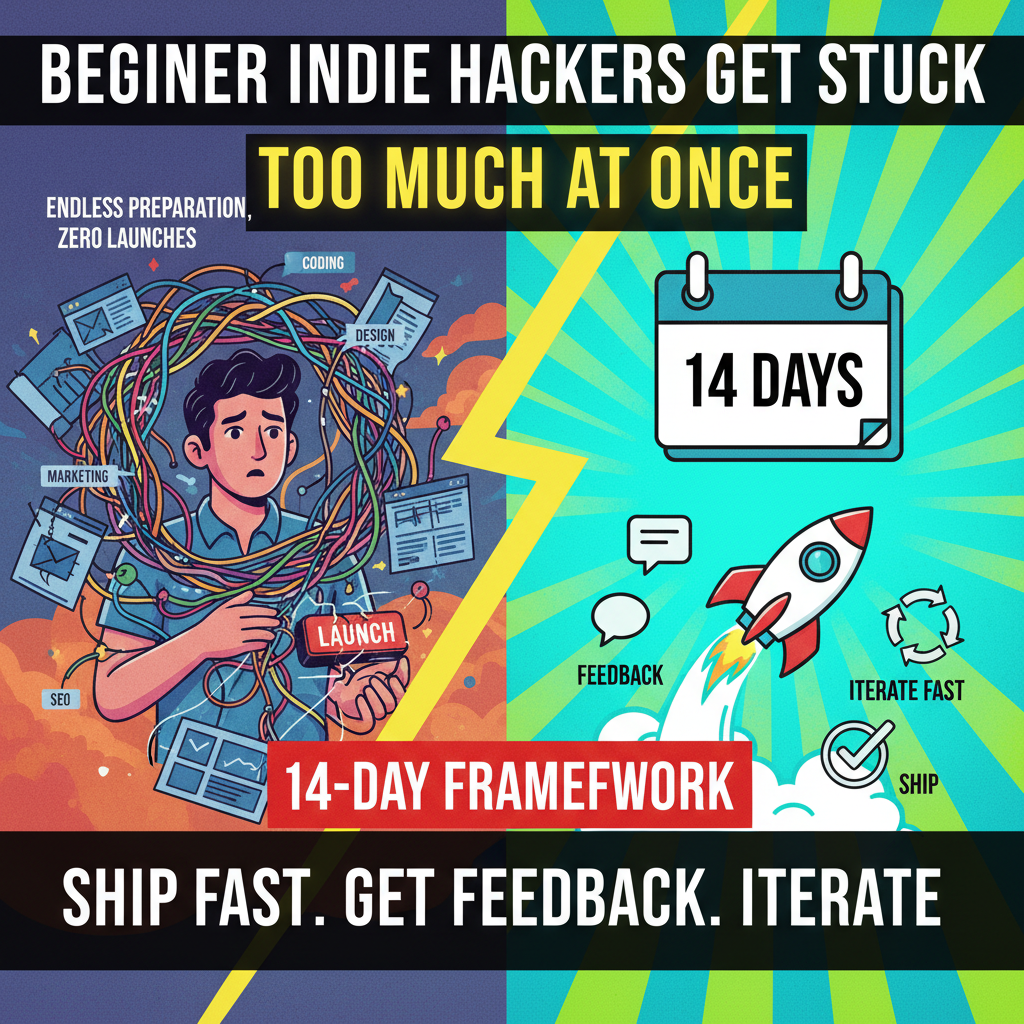
    Beginner indie hackers get stuck because they try to handle coding, design, marketing, and SEO all at once. The result: endless preparation, zero launches.

    This 14-day framework eliminates the noise. It forces you to ship, get feedback, and iterate fast.

    Day 1: Identify a Pain Point

    Focus entirely on the problem, not your software solution.

    • Goal: Pinpoint a specific daily frustration.
    • Core Questions:
      • Who has this problem? (e.g., freelance copywriters, Shopify merchants)
      • How do they solve it now? (e.g., manual copy-pasting, messy Excel files)
      • What tools are they paying for? (e.g., expensive agency software, sub-optimal plugins)
      • What is the cost of not solving it? (e.g., losing 2 hours daily, inaccurate reporting)
    • Action: Use Reddit, Google Search, and ChatGPT to list 3 potential problems.

    Day 2: Market Research

    Observe user discussions in communities (Reddit, X, Discord, Facebook groups, Product Hunt). Do not pitch. Just gather evidence.

    • Goal: List at least 10 real user complaints.
    • Where to look: Subreddits like r/shopify, r/marketing, or niche Facebook groups.
    • Log Format:
    User quote: "I hate copying my Shopify orders to Google Sheets every night."
    Current solution: Manual export/import.
    Opportunity: Automated background sync tool.
    

    Day 3: Validate Without Code

    Test market demand by posting a feedback-oriented question. Do not sell anything.

    • Goal: Get 10 comments, 5 DMs, or 5 waitlist signups.
    • Validation Template:
    I spend an hour every day manually importing invoices into my tax software.
    If there was a tool where you forward the invoice email and it automatically syncs with QuickBooks, would you pay $10/month for it?
    
    • Result: If nobody cares, pivot immediately. The pain isn't big enough.

    Day 4: Quick Branding & Landing Page

    Launch a simple page to capture emails. Spend no more than 3 hours on this.

    • Branding:
      • Name: Keep it simple (e.g., SyncCart, TaxFlow).
      • Design: Standard font, one primary color, text logo.
    • Landing Page Structure:
    Value Proposition (Headline + Slogan)
    ↓
    Problem & Solution (Short description)
    ↓
    Email Waitlist Form (CTA)
    

    Day 5: Start Building in Public

    Announce your 14-day build on X (Twitter), Reddit, or LinkedIn.

    • Goal: Establish accountability and start building an audience.
    • Launch Template:
    Day 1/14:
    I'm building SyncCart to automate Shopify-to-Sheets syncing.
    Building in public.
    Goal: Ship in 14 days, get 10 beta users.
    Follow along.
    

    Days 6 to 10: Build the MVP

    Write code for the core logic only. Spend 1-3 hours daily.

    • Development Rules:
      • Prioritize functionality over aesthetics.
      • Skip dashboards, settings, and complex auth if not critical.
      • Fix bugs that break the core loop; ignore minor design flaws.
    • Customer Discovery: DM the users who engaged on Day 3. Ask:
      • "What is the single hardest part of this task?"
      • "Why did you stop using your last solution?"
      • "What does your dream solution look like?"

    Day 11: Launch the MVP

    Deploy the product and launch it to your waitlist and communities.

    • Launch Channels: Product Hunt, Indie Hackers, target subreddits, X.
    • Launch Template:
    SyncCart is live.
    Automate your Shopify-to-Sheets orders in 1 click.
    Need brutal feedback. Please roast it.
    [Link]
    

    Day 12: Analyze & Gather Feedback

    Review user interactions and follow up immediately.

    • Metrics to Track: Signups, drop-off pages, core action completion rates.
    • Action: Email every user who signed up. Ask:
      • "Did the setup make sense?"
      • "What almost stopped you from using it?"
      • "What is missing that would make this a daily tool?"

    Day 13: Fix Bottlenecks

    Spend this day patching the biggest user drop-off points.

    • Fix List:
      • Onboarding friction (make it 1-click if possible).
      • Server errors and critical bugs.
      • Confusing UI copy.
    • Do Not: Add new features, integrations, or complex setups.

    Day 14: Review & Repeat

    Complete the first cycle and decide on next steps.

    • Daily Operating Routine:
      • Morning (30 mins): Reply to support, post updates, check database stats.
      • Afternoon: Write code, resolve tickets, optimize flows.
      • Evening: Write a 3-point daily recap:
    Today I learned: ...
    User feedback: ...
    Tomorrow: ...
    

    If the loop yields active users, double down. If there is zero interest, pivot to a new problem.

  • The Indie Hacker Paradox and Just-In-Time Learning

    The Indie Hacker Paradox and Just-In-Time Learning

    The Indie Hacker Paradox and Just-In-Time Learning

    The indie hacker goal is simple: Build a product and get users.

    Yet, you often get overwhelmed by a massive list of skills:

    • Development: Frontend (NextJS, React), Backend (NodeJS, Go), Database (Postgres, Supabase), Servers.
    • Operations: UI/UX (Figma), Marketing (X, Reddit), SEO, Copywriting, AI, Analytics, Sales, Support.

    Your brain asks: "What should I learn first?"

    You don't need to master all of them. You only need to master one core loop.

    The Indie Hacker Loop

    Every other skill is only valuable if it serves this cycle:

    flowchart TD
        A[Observe Problem] --> B[Build Tiny MVP]
        B --> C[Get It to Users]
        C --> D[Collect Feedback]
        D --> E[Iterate]
        E --> A
    

    Two Mentalities: Overload vs. Focus

    1. The Overload Mentality (Information Paralysis)

    Developers often construct an intimidating map of prerequisites before writing code:

    graph TD
        IH[Indie Hacker] --> Build[Build:<br/>NextJS, AI<br/>Database, Cloud]
        IH --> Marketing[Marketing:<br/>SEO, Ads<br/>Content, Social]
        IH --> Research[Research:<br/>Competitors<br/>AI News, Trends]
        IH --> Design[Design:<br/>Figma, Tailwind<br/>Assets]
        IH --> Admin[Admin:<br/>Analytics, Sales<br/>Support]
    

    Result: You feel "unprepared" and never launch.

    2. The Successful Indie Hacker Mentality

    They simplify their entire focus down to a single goal: Get 10 real users.

    graph LR
        Goal((Goal: 10 Users)) --> MVP[1. Build MVP Fast]
        Goal --> Find[2. Find 10 Users]
        Goal --> Chat[3. Talk to them]
        Goal --> Iterate[4. Fix bugs]
    
    • SEO? Not yet.
    • Ads? Not yet.
    • New Frameworks? Not yet.
    • Daily AI News? Not yet.

    Just-In-Time Learning

    Traditional learning (learn first, build later) fails solo devs. Switch to Just-In-Time learning: Build -> Hit Roadblock -> Learn the Specific Solution -> Resume.

    Real-world examples:

    • Week 1 (Build SaaS MVP): The app needs Google Login.
      • Action: Learn only how to integrate Auth (Clerk or Next-Auth). Ignore SEO and Ads.
    • Week 3 (5 active users): You don't know which features they use.
      • Action: Integrate PostHog or Google Analytics in under an hour.
    • Week 5 (Need organic traffic): You want the landing page to rank on Google.
      • Action: Learn basic SEO Meta tags to optimize the landing page.

    Developer Strengths and Traps

    • Strengths: High curiosity, love for building systems (e.g., custom boilerplates, configuring servers).
    • Weakness (The Trap): Believing "To build X, I must first master A, B, C, D, and E."
    flowchart TD
        X[Need Feature X] --> A[Learn Library A]
        A --> B[A recommends<br/>Architecture B]
        B --> C[B has newer<br/>Framework C]
        C --> D[Must learn Tool D<br/>to run C]
        D --> Stuck[Stuck for 3 months<br/>No Launch]
    

    The Solution: Switch to Action-Based Goals

    Set a clear, rigid action goal to kill perfectionism: Ship 12 tiny products in 12 months.

    Your new prioritization list:

    Task Priority Real-world example
    Build MVP Fast 10/10 Code the app core functionality in 3-5 days.
    Talk to Users 10/10 Send direct messages to 5 users on Reddit/X.
    Ship Product 10/10 Post the live link on Product Hunt and X.
    Basic Marketing 7/10 Write a simple text post explaining the problem.
    UI/UX Polish 5/10 Use a UI template; do not design custom buttons.
    Optimize Codebase 1/10 Use a simple database (Supabase/Vercel KV).

    Are you preparing to be an indie hacker, or are you actually building? A real indie hacker isn't someone who knows everything; they are someone lacking resources who ships anyway.

    What is your single KPI from now until the end of the year?

    • Ship 12 products?
    • Find your first 100 users?
    • Earn your first $100?

    Pick a concrete target and start tomorrow.